

Whiskey Rebellion Antiques
Type CCW-73037 Portable Generator
Type CCW-73037 Portable Generator
Excellent working condition!
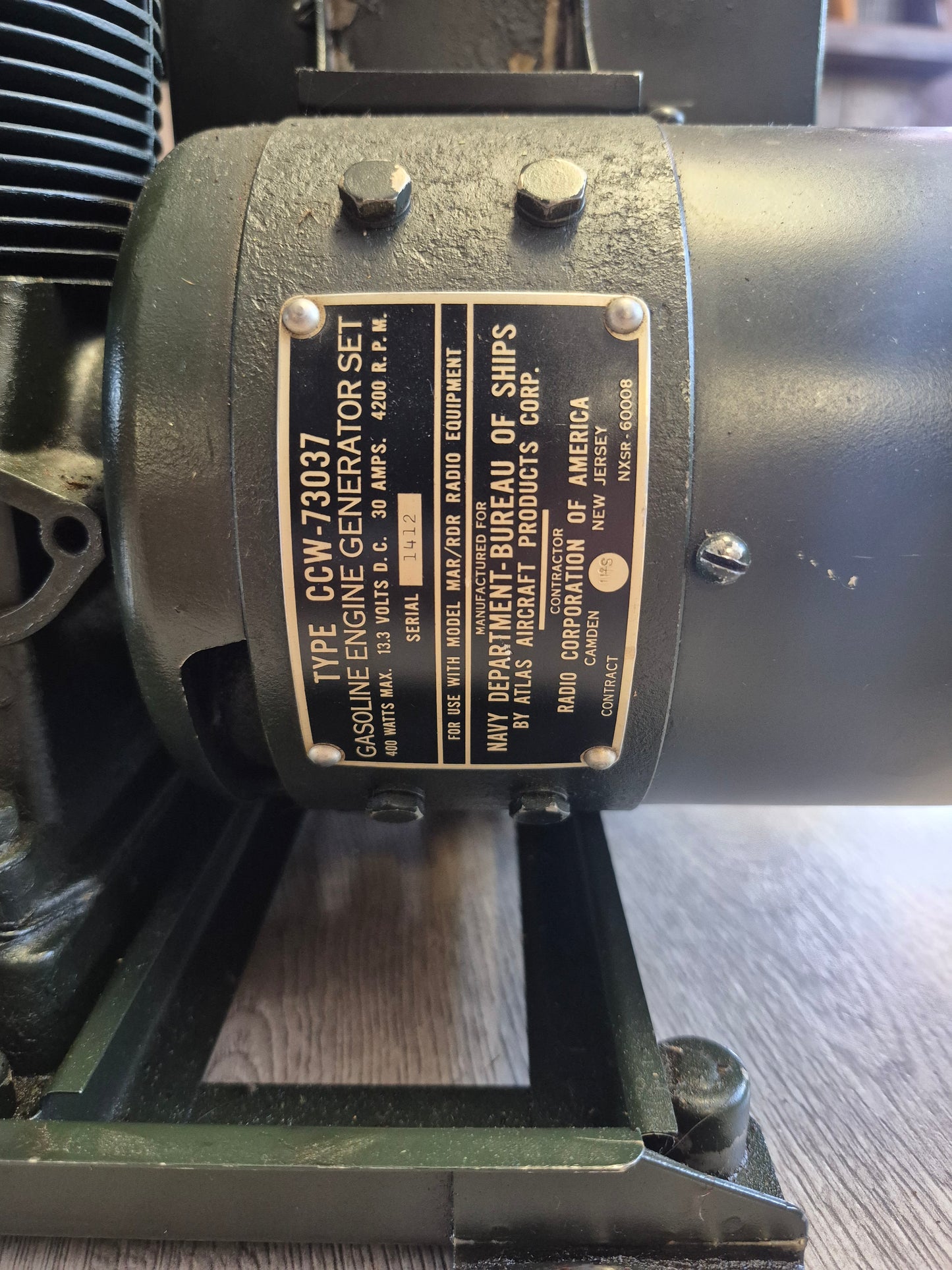
This is a WWII-era U.S. Navy portable gasoline engine-generator set, Type CCW-73037 (also referenced with contract NXsr-60008), manufactured primarily by Atlas Aircraft Products Corp. (with Radio Corporation of America of Camden, New Jersey, as contractor) for the Navy Department, Bureau of Ships.
It is rated at 400 watts maximum, 13.3 volts DC, 30 amps, at 4,200 RPM. The data plate indicates it is “FOR USE WITH MODEL MAR/RDR RADIO EQUIPMENT.” The engine is a Lauson (The Lauson Company, New Holstein, Wisconsin) unit with manufacturer’s serial number 7-57582 (and generator serial 1412 on the example shown). It includes a carrying case/cover marked “THIS END TO FACE CARRYING CASE COVER,” rope-start (with wooden handle), fuel tank, controls for radio/battery charge, automatic voltage regulator, and detailed operating/lubrication instructions on the engine plate (Navy Symbol oils, high-octane or regular gasoline, etc.).
History:
These compact sets were built during World War II to supply DC power for Navy radio equipment, specifically the MAR/RDR series. The MAR was a UHF transceiver (transmitter-receiver) used for line-of-sight voice and code communications; the associated RDR was the companion receiver. The generator could power the radios directly or charge batteries.
Lauson (a Wisconsin engine maker known for small industrial, marine, and later aluminum military engines) supplied the lightweight, often aluminum-block powerplants for such portable military gear to reduce weight for field/shipboard/amphibious use. Atlas Aircraft Products handled the generator end. Similar Lauson-powered Navy radio generators appear in period documentation and collector discussions (e.g., Smokstak forums), confirming their role in supporting portable and transportable Navy/Marine communications sets of the era.
The overall design is typical of wartime “power units” for radio: rugged olive-drab finish, sealed features for transport, rope start, and dual radio/battery-charge switching. They were part of the broader effort to equip ships, shore stations, and mobile units with reliable portable power independent of ship’s mains or large generators.
Couldn't load pickup availability